DJI Dock 3, Matrice 4D/4TD, and FlightHub 2 details are summarized from DJI's published material as of July 2026 and are not independently verified. Specs, availability, and pricing vary by region and change; confirm against DJI's current pages and your dealer.
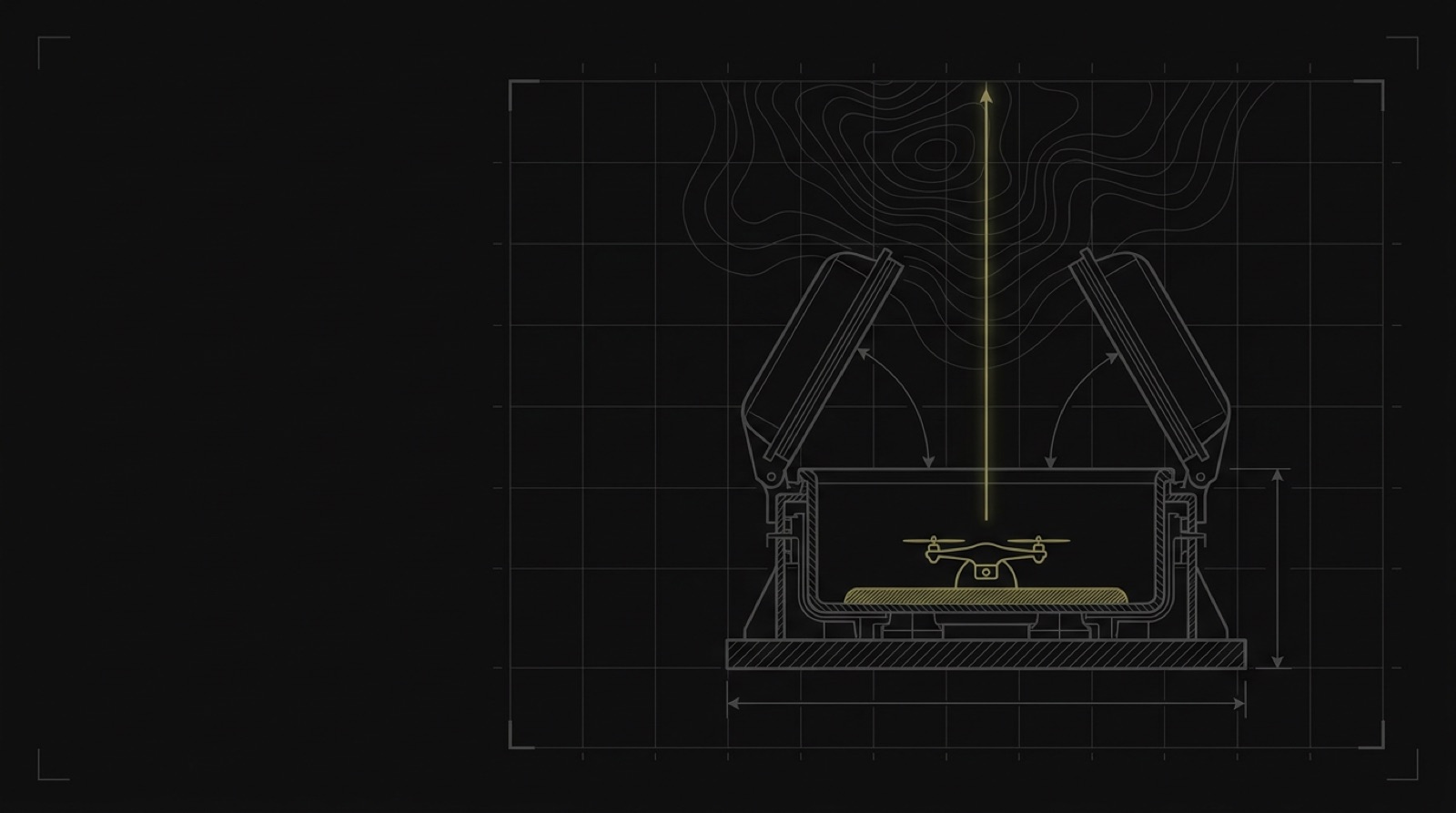
DJI Dock 3 is DJI's drone-in-a-box: a weatherproof station that houses, charges, and launches a drone on its own, so a site can fly scheduled or on-demand missions with no pilot standing next to the aircraft. It launched in February 2025 as DJI's first dock that can be mounted on a vehicle, which moved the category from a fixed installation to something an operations team can drive to where the work is.
This guide covers what Dock 3 actually is, the Matrice 4D and 4TD aircraft it flies, what deployment takes, what it costs, and, because DJI's page won't tell you, where it stops.
A dock is the answer to a staffing problem. Routine flights, perimeter patrols, inspection circuits, and first-look response don't need a pilot on site if the aircraft can launch, fly a planned mission, land, and recharge by itself. Dock 3 does exactly that: the station holds a Matrice 4D-series aircraft, keeps it charged and climate-protected, launches it on schedule or on command, and streams the flight back to wherever the operation is run from.
The operating model matters as much as the hardware. Remote operations from a dock still run under aviation rules: in the United States, flying beyond visual line of sight generally requires a waiver or exemption today, and the proposed Part 108 is the framework that would normalize it. The dock automates the aircraft's day; it does not automate the authorization.
Dock 3 flies the DJI Matrice 4D or Matrice 4TD, and the choice between them is the real configuration decision.
Both are IP55-rated with up to 54 minutes of forward flight and 47 minutes hovering, and both carry a three-camera stack plus a laser range finder: a wide-angle camera, a medium tele at 70 mm, and a 168 mm tele. Night Scene mode gives full-color night vision on both.
The Matrice 4D is the mapping and inspection variant: its 24 mm wide camera uses a 4/3 CMOS, 20 MP sensor with a mechanical shutter, which is what you want for photogrammetry. The Matrice 4TD trades that for a thermal camera plus a near-infrared auxiliary light with about 100 meters of reach, aimed at public safety, security, and night inspection work. If the mission is measurement, choose the 4D; if the mission is finding people and heat, the 4TD.
Earlier docks were civil-works projects: a pad, power, connectivity, and a fixed spot. Dock 3 keeps that option and adds vehicle mounting, with horizontal calibration and cloud-based location calibration so the dock can operate from a truck bed. Two docks can run on one vehicle for dual-drone rotations, one aircraft flying while the other charges, which is how continuous coverage actually gets staffed.
For fixed sites, a D-RTK 3 Relay (Fixed Deployment Version) strengthens video transmission and satellite acquisition against interference. Environmental tolerance is wide: the dock operates and charges from −30 °C (pre-heated) to 50 °C, carries an IP56 rating, and the aircraft's low-noise anti-ice propellers hold stable flight in freezing rain and wind to 12 m/s.
Dock operations live and die on the link. Beyond the dock's own connectivity, the Matrice 4D series has an airborne relay mode: with the DJI RC Plus 2 Enterprise controller, one aircraft flies as a relay that extends another aircraft's operational range, including where there is no 4G at all, in mountains, or behind obstructions. For search and rescue or inspection in broken terrain, that relay is the difference between a plan and a flight.
How far a single dock covers depends on transmission conditions, terrain, and configuration; DJI's spec page lists the operating radius for each setup, and the relay extends it situationally rather than as a fixed number.
Dock 3 is operated through DJI FlightHub 2, DJI's cloud platform: mission scheduling, the live dashboard, media management, and fleet administration all live there, and a dock deployment without it is not a supported configuration. Dock scheduling and automated missions live in DJI's tooling. For the live layer, DJI's Cloud API lets platforms connect to the aircraft directly, so live video and telemetry can reach an outside system without passing through FlightHub 2; FlightHub 2 can also push streams out over RTMP.
We wrote a full, independent guide to that platform, including its plans, its metered-livestream pricing, and its limits: DJI FlightHub 2: The Complete Guide.
Three additions are worth knowing about. The Obstacle Sensing Module adds LiDAR and millimeter-wave radar for precise maneuvering around structures as fine as 12 mm power lines and substation layouts. The DJI AL1 gimbal-following spotlight illuminates what the camera looks at, up to about 100 meters. The DJI AS1 speaker broadcasts to about 300 meters at up to 114 dB at one meter, with recorded messages, media import, and text-to-speech. DJI Enterprise also supports third-party payloads on the platform.
DJI does not publish a US list price for Dock 3. It is sold through DJI enterprise dealers as a quoted package, typically the dock plus a Matrice 4D or 4TD, installation, and a DJI Care Enterprise plan, and reseller listings vary by configuration and region. Budget conversations should also include the operating side: FlightHub 2's tier (and its livestream metering on the Business plan), connectivity at the site or vehicle, and the regulatory work for remote operations. The dock is the visible line item; the program around it is the real cost.
Three limits shape whether a dock program works, and none of them are on the product page.
Dock management is FlightHub 2, full stop. The dock's scheduling, mission automation, and device management live in DJI's console, and no third-party platform manages the dock itself today. The live layer is more open: through the DJI Cloud API, an outside platform can take the aircraft's video and telemetry directly. Verify which of the two layers your system needs before you buy.
Sharing the picture is where the ecosystem ends. A dock produces continuous video; the people who need it, clients, a command center you don't run, a city operations room, are usually outside your FlightHub 2 organization. Getting the live picture to them cleanly, without metering math or platform accounts, is not the dock's job.
The regulation is still yours. A dock does not come with flight authorization. Remote and beyond-visual-line-of-sight operations need the approvals your jurisdiction requires; in the US, our Part 107 vs Part 108 guide covers what the proposed rules change and what they don't.
DJI launched DJI Dock 4 on 14 October 2026. It flies the Matrice 5TD and swaps the aircraft's battery in under 25 seconds instead of charging it in place, per DJI. The Dock 4 guide covers its specs and its status in the United States.
Dock scheduling, automated missions, and dock management stay in DJI's tooling. Nebli covers the piloted side of the same operation: DJI Pilot 2 on an enterprise remote pushes the aircraft's live feed to Nebli over RTMP, with no FlightHub 2 or Cloud API license needed (DJI Pilot 2 live streaming). Nebli carries that feed on a PIN-gated browser link that any number of viewers open with no install and no per-minute meter, with AI detection running on the feed under rules you write in plain language. It also carries PX4 and ArduPilot drones and any RTSP camera. The Nebli vs DJI FlightHub 2 comparison covers how the two layers divide the work.
It is a drone-in-a-box: a weatherproof station that houses, charges, and automatically launches a Matrice 4D-series drone for scheduled or on-demand remote missions, operated through DJI FlightHub 2.
DJI does not publish a US list price. Dealers quote it as a package with the aircraft, installation, and care plan, and configurations vary; expect the software tier, connectivity, and regulatory work to add to the program cost.
The operating radius depends on configuration, terrain, and transmission conditions; DJI's spec page lists the radius per setup, and the Matrice 4D series' airborne relay mode extends reach in obstructed or no-4G environments.
The DJI Matrice 4D (mapping and inspection, mechanical-shutter wide camera) and Matrice 4TD (thermal plus near-infrared light for public safety and night work).
Yes, for the dock itself: scheduling, mission automation, and dock management run through DJI FlightHub 2. Live video and telemetry can also reach outside platforms directly through the DJI Cloud API.
DJI Dock 3, Matrice 4D/4TD, and FlightHub 2 details are summarized from DJI's published material as of July 2026 (product pages and DJI's 2025-02-27 launch announcement) and are not independently verified. Specs, availability, and pricing vary by region and change; confirm against DJI's current pages and your dealer.
