FlightHub 2 details are summarized from DJI's published material as of July 2026 and are not independently verified. Pricing and quotas vary by region and change; confirm against DJI's current pages.
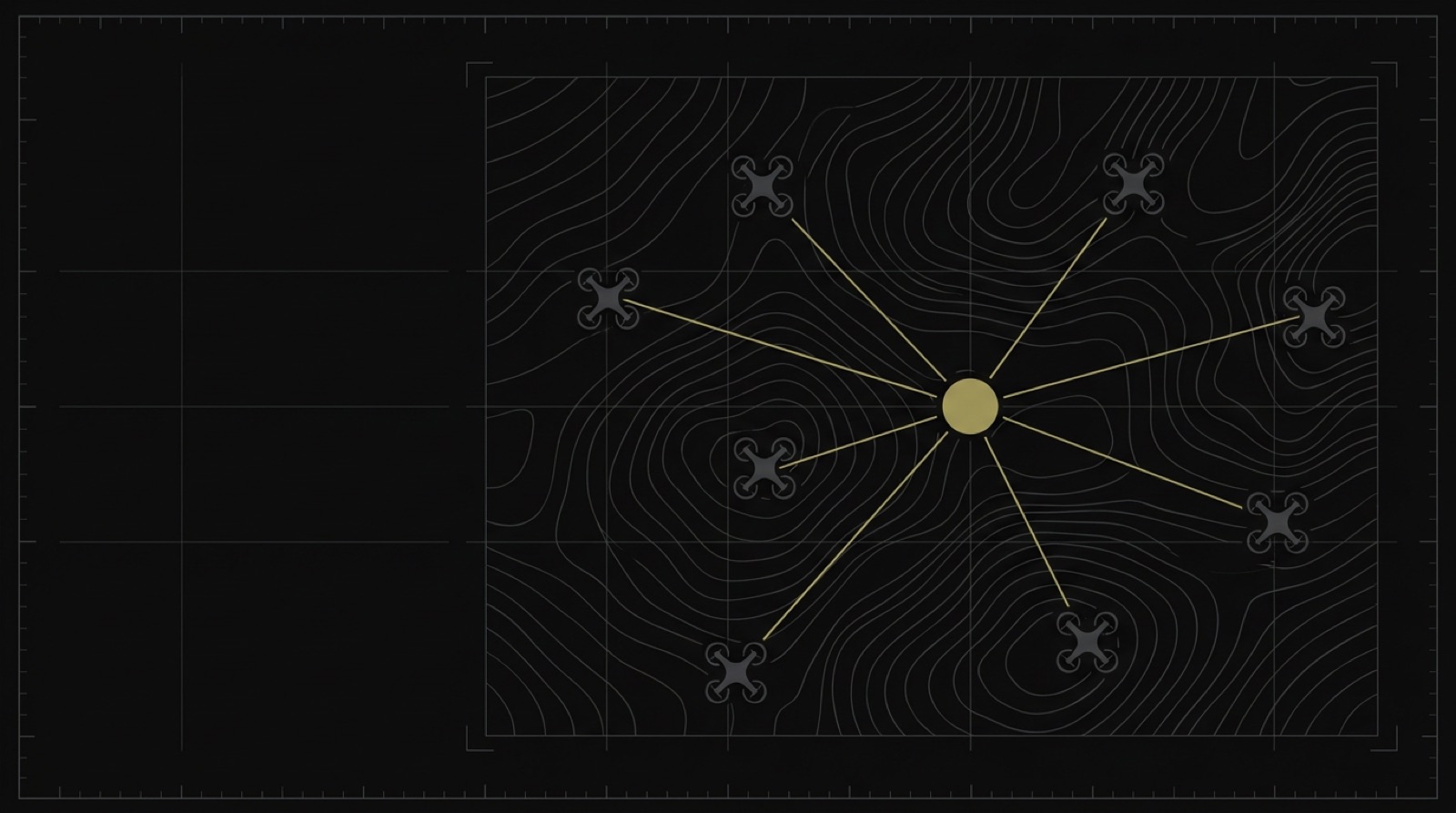
DJI FlightHub 2 is DJI's cloud platform for managing a fleet of DJI drones: mission planning, live operations, mapping, and media management in one console. If you fly DJI enterprise aircraft, you will run into it sooner or later, either because a DJI Dock requires it or because someone on your team wants flight logs and firmware in one place.
This guide covers what FlightHub 2 actually does, what it costs, which hardware it supports, and, because DJI's own pages won't tell you, where it stops.
FlightHub 2 is a cloud-based fleet management system. Aircraft connect through the DJI Pilot 2 app on the controller or through a DJI Dock, and the platform gives your organization a shared operations picture: a live map, drone status, flight logs, media management, and streamlined team communication in one centralized dashboard.
The core idea is ground-to-cloud synergy. What the pilot sees in the field, the operations room sees in the console: teams position on a shared 2.5D base map, mission details, operation results, and rapid sharing of media as it lands. One-tap panorama sync and cloud-based reconstruction turn field captures into high-precision 2D and 3D models without a separate desktop workflow.
The live side of FlightHub 2 is its strongest ground. The dashboard carries mission live streaming from every connected aircraft, with multi-drone control and simultaneous livestreams for larger operations. The virtual cockpit view puts one aircraft's camera, telemetry, and flight data reporting on one screen; live annotations let the operations room mark a target on the shared map for every pilot to see.
Two details matter for safety-conscious operators. ADS-B data surfaces crewed-aircraft traffic near your operation, and AR street overlays project street names and building outlines onto the video feed, which helps an operator orient fast in dense environments.
DJI also describes conversational remote control features built on a vision-language model (VLM): an operator types or speaks an instruction and the platform translates it into a camera or flight action. DJI positions these as operator-directed tools; a certificated pilot remains in command of the aircraft, and the platform relays what the operator decides.
FlightHub 2 plans missions on a 2.5D base map with several route types: waypoint routes for precise paths, area routes for coverage, linear routes for corridors like pipelines and roads, and slope routes and geometric routes for terrain-aware capture. Patrol routes repeat a fixed inspection circuit; mapping routes feed the reconstruction pipeline; Smart 3D Capture plans the shots a 3D model needs.
Automated triggered workflows connect events to responses, so an alarm from a connected system can cue a pre-planned Dock mission. FlightHub 2 Copilot is DJI's assistant layer over planning and operations. As with any automation in a regulated airspace, the operator's procedures and authorizations still govern what actually flies; the scheduling is the easy part.
The platform's AI features cluster around detection and search. Multimodal object detection finds people, vehicles, and vessels in the feed and can raise automatic alerts; continuous tracking follows a detected subject; intelligent detection actions tie a detection to a response, like starting a recording. AI change detection compares passes over the same site and flags changed areas, which is useful for stockpile, construction, and security work.
AI Patrol applies these intelligent algorithms to repeated routes, and DJI's AI agent direction, built on a multimodal large language model (LLM), extends into multimodal media search: type what you are looking for and the platform searches your media library by content, not filename. Algorithm management lets an organization control which models run where.
Two honest notes. First, these features run inside the DJI ecosystem, on DJI aircraft and DJI-managed media. Second, marketing names change faster than capabilities; verify the specific detection behavior you need against a live demo, not a feature list, before you commit an operation to it.
FlightHub 2's analysis tools are aimed at operators who need answers from the imagery, not just pictures. Cloud reconstruction produces the models; measurement and calculation tools take point, line, and polygon measurements off them; coordinate transformation tools handle local grids. Site assessment work leans on comprehensive analysis tools and statistical analyses of change over time.
On the reporting side, automated data collection rolls flights into flight summary reports and detailed logs, and a measurement report or analyzer result sharing link moves results to stakeholders. For an inspection or survey business, this reporting layer is a real differentiator against flying the same missions with a consumer app.
Post-mission review turns raw flights into data utilization: what was captured, what changed, and what needs a follow-up pass.
DJI has invested in certifiable answers here: ISO/IEC 27001 security compliance and ISO 27701 privacy compliance cover the information security management system standards most procurement teams ask about. Operational controls include multi-factor authentication (MFA), single sign-on (SSO), secure integrations, and custom project roles and permissions, so a large organization can bind accounts to its identity provider and scope who sees which project.
Airspace-side, the platform supports geofencing with custom geo zone support and no-landing zones, Remote ID broadcast compliance, and redundant control links on supported hardware. Data privacy posture, including where media is stored and processed, depends on your region and plan; organizations with strict data residency requirements should ask DJI directly about hosting options, including on-premises deployment, before assuming the cloud default fits.
FlightHub 2 is built for DJI enterprise hardware: the DJI Matrice 4 series, Mavic 3 Enterprise series, and payloads like the Zenmuse H30 series, plus DJI Dock 3 for remote, scheduled operations, with device binding tying each aircraft to your organization. The Manifold 3 onboard computer extends edge processing on supported aircraft.
Integration beyond the DJI ecosystem runs through three doors. FlightHub Sync moves data between FlightHub 2 and third-party systems. The OpenAPI lets developers pull flight data and media programmatically. And RTMP/RTSP protocols carry video in and out: FlightHub 2 can push a livestream out via RTMP, which is also how third-party platforms receive a FlightHub 2 feed. Third-party airspace management data can be brought into the operational picture as well.
The boundary is worth stating plainly: FlightHub 2 manages DJI aircraft. It is not positioned as a home for your PX4 or ArduPilot fleet, your fixed RTSP cameras, or the mixed hardware most real operations accumulate. Those feeds live outside it.
DJI sells FlightHub 2 in tiers, per public sources as of mid-2026:
The metering detail deserves attention because it changes the economics of sharing video. On the Business tier, livestream billing counts total viewing time across the platform, so every additional simultaneous viewer multiplies the minutes you burn. A fleet that streams a lot to a lot of people either budgets for recharges or buys Enterprise.
How you assemble a plan matters as much as the tier. The solution configurator is where an organization sizes its purchase plan: the free quota covers a baseline of livestream time, cloud storage space, and a set number of mapping images, and an add-on plan extends whichever quota you outgrow first, from data consumption to storage. The Pro version capabilities unlock at the top of the range, and organization binding ties the whole configuration to your org account rather than an individual pilot, which is what larger programs need for procurement and audit.
For a DJI fleet, this is the native answer, and it shows. Firmware, batteries, pilots, and missions live in one console. Dock operations are first-class. The mapping and reconstruction pipeline is genuinely integrated rather than bolted on. And the compliance surface, from ISO certifications to Remote ID, is the kind procurement teams can check boxes against. If your operation is DJI end to end and your video stays inside your own team, FlightHub 2 is a strong default.
Three limits come up consistently for operators evaluating it, and none of them appear on DJI's product pages.
It is DJI-only by design. Non-DJI drones, fixed cameras, and other field sensors are not what it manages. Mixed fleets need a second layer.
Sharing outside your organization is where metering bites. The platform is built for your team watching your operation. The moment the audience is a client, a command center you don't run, or the public, Business-tier viewing-time metering makes each viewer a line item, and share workflows stay inside the DJI platform.
Detection is fleet-centric. The AI features watch DJI feeds inside DJI's console. If you need natural-language detection rules running on a mixed set of feeds, drones and fixed cameras together, that sits outside its documented scope.
None of this is a flaw in what FlightHub 2 is. It is DJI's cockpit for DJI fleets, and it is good at that. The limits only matter when your operation's shape is different from the one it was built for.
Dock scheduling, automated missions, and dock management stay in DJI's tooling. For piloted DJI aircraft, DJI Pilot 2 pushes the live feed from the remote straight to Nebli over RTMP, without FlightHub 2 in the path (DJI Pilot 2 live streaming). Nebli covers the live operations layer. It carries live video from DJI aircraft flown from a remote, PX4 and ArduPilot drones, and any RTSP camera, to anyone who needs to watch it, on a PIN-gated browser link with no install, no per-minute meter, and no per-viewer math. AI detection runs on the feed itself, with rules you write in plain language, and every tier streams flat and unlimited. A free tier tests it end to end with your own aircraft.
Plenty of operations run both: FlightHub 2 as the fleet cockpit, Nebli carrying the piloted feeds to clients and command centers. If that shape sounds like yours, the Nebli vs DJI FlightHub 2 comparison has the side-by-side detail, and the streaming cost calculator does the metering math against your fleet.
The Standard tier is free per organization. Business (about $1,600/yr) and Enterprise (about $3,280/yr) add capacity, quotas, and unlimited or very-high livestream, per DJI's public material.
No. It manages piloted aircraft through DJI Pilot 2 as well. A Dock requires FlightHub 2, not the other way around.
Sharing is built around the DJI platform and your organization's accounts. Streaming out to third parties runs over RTMP to external services, and on the Business tier, viewing time is metered across the platform.
It is built for DJI enterprise aircraft and is not positioned as a manager or relay for third-party hardware. Mixed fleets typically pair it with a vendor-agnostic layer.
DJI enterprise platforms, including the Matrice 4 series and Mavic 3 Enterprise series, payloads like the Zenmuse H30 series, and DJI Dock 3 for remote operations, per DJI's current compatibility lists.
FlightHub 2 details are summarized from DJI's published material as of July 2026 and are not independently verified. Pricing and quotas vary by region and change; confirm against DJI's current pages.
